Public Housing Transfers: longer-term impacts on investment, tenant experience and sector outcomes

Through transfer programs, community housing providers have gained credibility, influenced regional planning, contributed to policy and regulatory development, and strengthened their role as advocates and government partners.

Public housing transfers have been a prominent government strategy for growing Australia’s community housing sector for decades. Their aim has been to improve economic efficiency, expand the community housing sector and enhance tenant outcomes. However recent changes to program scale, contract terms, resourcing and service delivery have resulted in divergent outcomes.


Published by AHURI in March 2026 this research project examines the long-term impacts of transferring public housing to community housing providers in Australia. It explores how large-scale property transfers have influenced their operations, finances, tenant services and outcomes, and identifies policies to support the wider goals of transfer programs. The research involved a literature review, an online survey and three case studies - one each in New South Wales, Victoria and South Australia. 


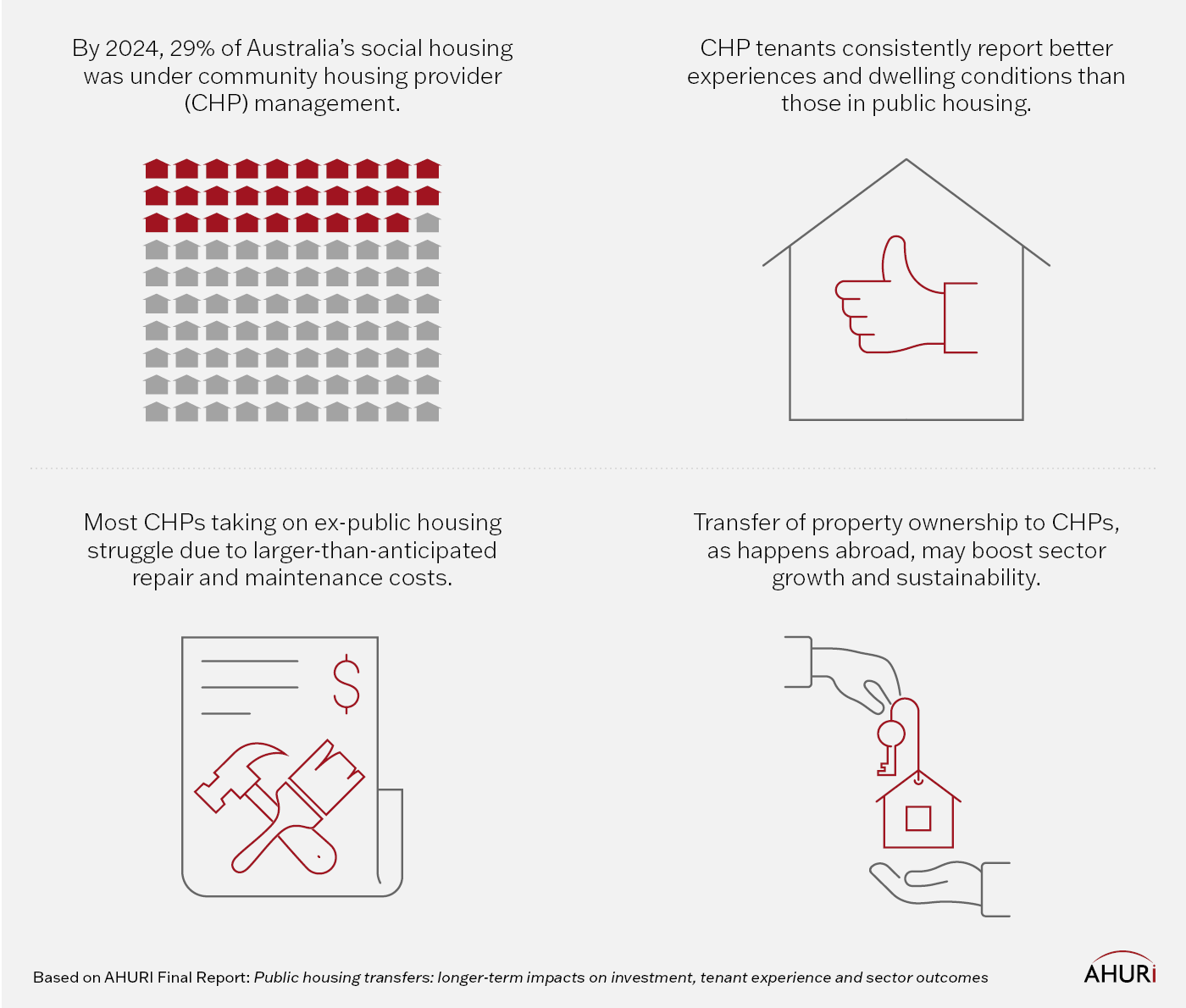
Researchers found that community housing providers have gained credibility, influenced regional planning, contributed to policy and regulatory development, and strengthened their role as advocates and government partners. Transfer programs have also resulted in
community housing tenants consistently reporting improved experiences and conditions compared to those in public housing.


Of concern is transfer of ownership to community housing providers is rare. Without ownership, their ability to invest in upgrades, dispose of unsuitable assets or reinvest in new developments is limited. Additionally, transferred properties are often in worse condition than anticipated. Combined with the expectation to expand tenant and community services without additional funding, they experience financial and sustainability constraints.


Recommended policy actions


  • Enable title transfer. Title transfers allow community housing providers to carry out long term planning and unlock financial tools to support reinvestment.
  • Build flexibility into programs. By working collaboratively with the community housing sector on transfer processes and terms, governments can enable stronger outcomes, more innovation and expanded housing supply.
  • Consider a staged approach. Staged models support improved collaboration pre-transfer and allow time to build organisational capacity. They especially benefit smaller and regionally based community housing providers and those supporting specialist tenant cohorts.
  • Resource expanded scope. By allocating appropriate funding, governments enable community housing providers to meet program objectives, maintain service quality and avoid undermining their financial viability. 
  • Focus on program outcomes. Develop a fuller picture of this program’s effectiveness by co-designing frameworks which focus on social and tenant outcomes and not just the financial and operational compliance.


Sean’s thoughts


Public Housing Transfers are often beset by political ideology – some see it as privatisation, others see it as gaining leverage and accelerating growth. Community housing and public housing are two sides of the same coin and complement each other in different ways. The economies of scale that public housing authorities bring cannot be understated, likewise the increase in funding and tenure flexibility that is offered by community housing offers a more bespoke service to tenants. Perhaps the next logical question that we need to ask is, what can each side of this coin learn from the other?


This is paragraph text. Click it or hit the Manage Text button to change the font, color, size, format, and more. To set up site-wide paragraph and title styles, go to Site Theme.

Share This Article

Other articles you may like

August 10, 2025
The AHI acknowledges the tireless efforts of those working within the homelessness sector, supporting the thousands of people experiencing homelessness and searching for meaningful pathways to live normal, productive and healthy lives. Our #HomelessnessWeek2025 sector forum in Sydney saw over 150 leaders, workers, politicians, policy makers, social impact collaborators, change makers and – most importantly - people with lived experience come together to talk about the impact of homelessness and share innovative responses within our community. Collaboration is key and the vibe in the room was inspiring. Real people making real differences. But we know it is far from enough and we must all strive to do more. We commend the NSW Minns Government, in particular the Hon Rose Jackson MLC, for their bold commitment to ‘make homelessness rare, brief and not repeated because people have a safe home and the support to keep it’ through the release of the NSW Homelessness Strategy 2025-2035. Thanks to Rebecca Pinkstone CEO Homes NSW and Dom Rowe CEO Homelessness NSW for their strong leadership and commitment to ending homelessness and providing more people with a home. The AHI continues to support and connect the workers who turn up, show up and get things done. Every single day. For more information, visit: https://www.nsw.gov.au/departments-and-agencies/homes-nsw/nsw-government-response-to-homelessness/nsw-homelessness-strategy-2025-2035 #HomelessnessWeek2025 #HomelessnessActionNow #Makeadifference #Leadingchange 
AI governance for community housing
By Dentons June 17, 2025
Love it or hate it, artificial intelligence is here to stay, and it’s playing an increasingly important role in housing. The Dentons team - Michael Park (Partner) and Antonia Hudson (Senior Associate) - provide us with a legal update on the use of AI for the Australian community housing sector, and AI governance tips for leaders of all organisations.
Harry Smith, new Australasian Housing Institute CEO
April 2, 2025
Harry Smith has recently commenced his role at the ahi as CEO after 26 years in the social services and government sectors across a range of diverse responsibilities. Harry brings a wealth of sector-specific knowledge and experience, supporting our members and our wider community.
More Articles