Better Futures for Unaccompanied Children and Young People Experiencing Homelessness

We need to strengthen the system of care to better align homelessness services to the needs of unaccompanied children and young people.

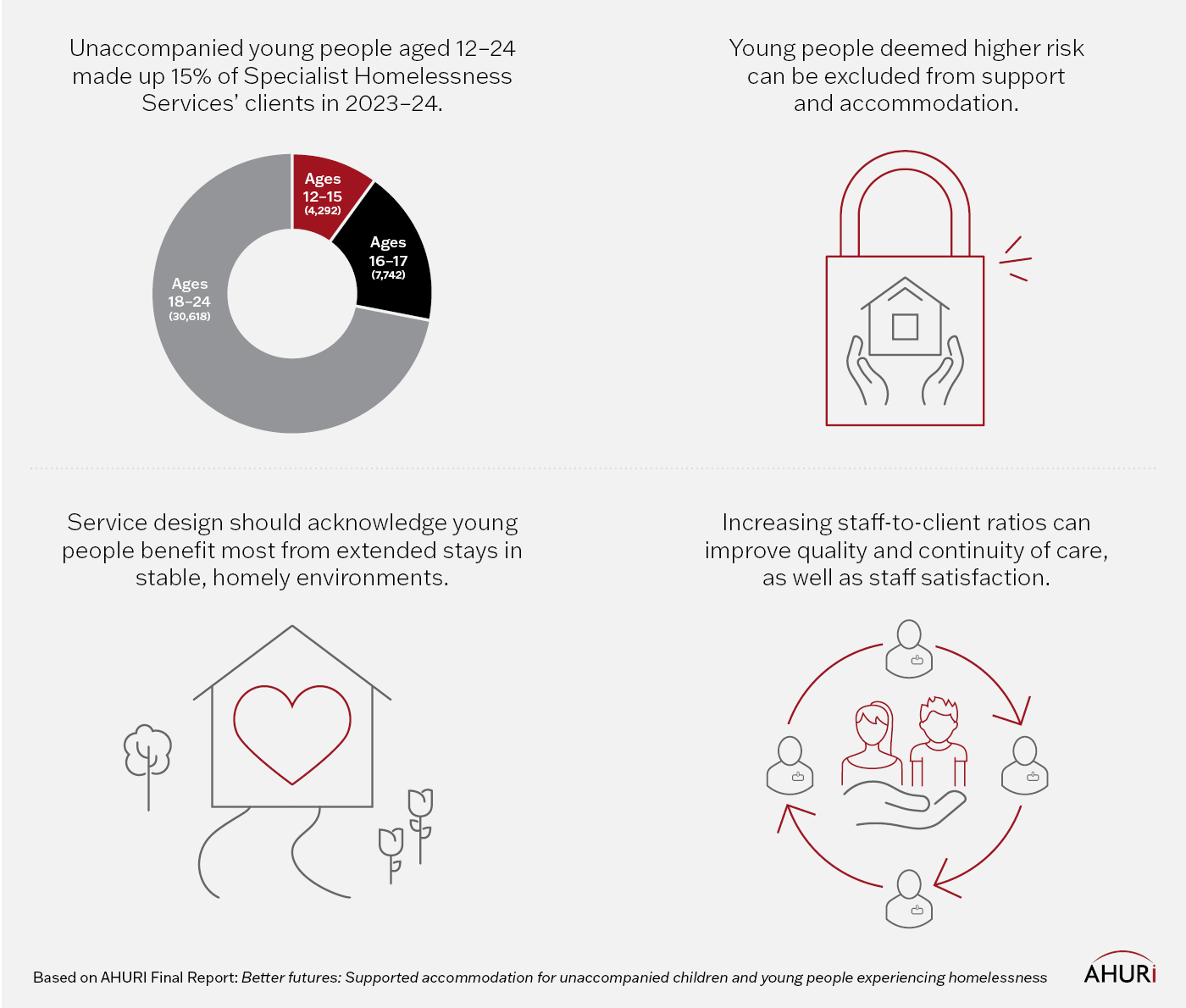
Just over 42,500 people aged 12-24 were supported by homelessness services in 2023-24 while unaccompanied by a parent or guardian. Yet, due to design and resourcing constraints, these services don’t always meet the age-related and developmental needs of young people.


Published by AHURI in April 2026, this research project examines the effectiveness of supported accommodation services in meeting their needs and proposes a range of principles to guide policy and practice towards a stronger system. In addition to reviewing the available data, researchers undertook interviews in Tasmania and Victoria with 51 unaccompanied people aged 14+ and with 29 social housing service and youth outreach practitioners. A National Practitioner Advisory Group and the Yfoundations
https://www.yfoundations.org.au Youth Homelessness Representative Council also provided guidance and critical review.


Researchers found, that in addition to the system not being designed for unaccompanied children and young adults, their homelessness is primarily linked to lack of guardianship and care, rather than lack of affordable housing as with adults. This means that solutions should focus on support to help young people transition to adulthood so they can build positive family and community connections.


Despite their lack of guardianship, parents retain legal responsibility for any children who are not under child protection orders. This can result in situations where children receive neither guardianship at home nor any response from child protection services.


Another aspect which creates difficulty is that care for children and young people can be restricted, temporary and dependent on meeting certain conditions, rather than provided according to need. If they are perceived as higher risk, they may be excluded from services because their vulnerability exceeds service risk thresholds, capabilities and capacities.


Recommended policy actions


  1. Include unaccompanied homeless children and young people in policy, system and service design. Government commitments to engage youth advisory councils on key policy areas could be expanded to include unaccompanied children who have experienced homelessness, in particular under-14s, whose voices are rarely heard in research.
  2. Design and deliver age-appropriate supported accommodation services. A care continuum and child and youth-focused model that improves their entry and assessment and prioritises their rights, safety, wellbeing and development is recommended. 
  3. Unconditionally match service design and resourcing to the complexity of homeless children and young people’s care needs. Young people benefit most from extended stays in stable, homely environments that enable them to rest, recover and build trust. They also need access to appropriate services in health, welfare, education and employment.
  4. Strengthen responses to unaccompanied homeless children and young people at a national level. A National Child and Youth Housing and Homelessness Plan is recommended to provide strategic direction for policy reform and drive service innovation, care standards and good practice across states and territories.


Sean’s thoughts


“Nothing about us, without us”. This has been the rallying call for many marginalised groups over the year, and we again find ourselves dealing with systems that are not meeting the needs of its users. This is the result of the changing nature of homelessness in Australia – a change that has yet to be addressed head on. Youth Homelessness is not an extension of Adult Homelessness. Our current reality is that we’re attempting to solve child protection issues with a housing-led response. While housing will invariably be part of the solution, it is perhaps not the first lever to pull.


The level of demand for homelessness services is only rising, and while the solutions to these issues may be similar to those already in place, we clearly need to expand and evolve these services to adjust to this changing need.


This is paragraph text. Click it or hit the Manage Text button to change the font, color, size, format, and more. To set up site-wide paragraph and title styles, go to Site Theme.

Share This Article

Other articles you may like

August 10, 2025
The AHI acknowledges the tireless efforts of those working within the homelessness sector, supporting the thousands of people experiencing homelessness and searching for meaningful pathways to live normal, productive and healthy lives. Our #HomelessnessWeek2025 sector forum in Sydney saw over 150 leaders, workers, politicians, policy makers, social impact collaborators, change makers and – most importantly - people with lived experience come together to talk about the impact of homelessness and share innovative responses within our community. Collaboration is key and the vibe in the room was inspiring. Real people making real differences. But we know it is far from enough and we must all strive to do more. We commend the NSW Minns Government, in particular the Hon Rose Jackson MLC, for their bold commitment to ‘make homelessness rare, brief and not repeated because people have a safe home and the support to keep it’ through the release of the NSW Homelessness Strategy 2025-2035. Thanks to Rebecca Pinkstone CEO Homes NSW and Dom Rowe CEO Homelessness NSW for their strong leadership and commitment to ending homelessness and providing more people with a home. The AHI continues to support and connect the workers who turn up, show up and get things done. Every single day. For more information, visit: https://www.nsw.gov.au/departments-and-agencies/homes-nsw/nsw-government-response-to-homelessness/nsw-homelessness-strategy-2025-2035 #HomelessnessWeek2025 #HomelessnessActionNow #Makeadifference #Leadingchange 
AI governance for community housing
By Dentons June 17, 2025
Love it or hate it, artificial intelligence is here to stay, and it’s playing an increasingly important role in housing. The Dentons team - Michael Park (Partner) and Antonia Hudson (Senior Associate) - provide us with a legal update on the use of AI for the Australian community housing sector, and AI governance tips for leaders of all organisations.
Harry Smith, new Australasian Housing Institute CEO
April 2, 2025
Harry Smith has recently commenced his role at the ahi as CEO after 26 years in the social services and government sectors across a range of diverse responsibilities. Harry brings a wealth of sector-specific knowledge and experience, supporting our members and our wider community.
More Articles