Workplace Trauma on the Social Housing and Homelessness Frontline

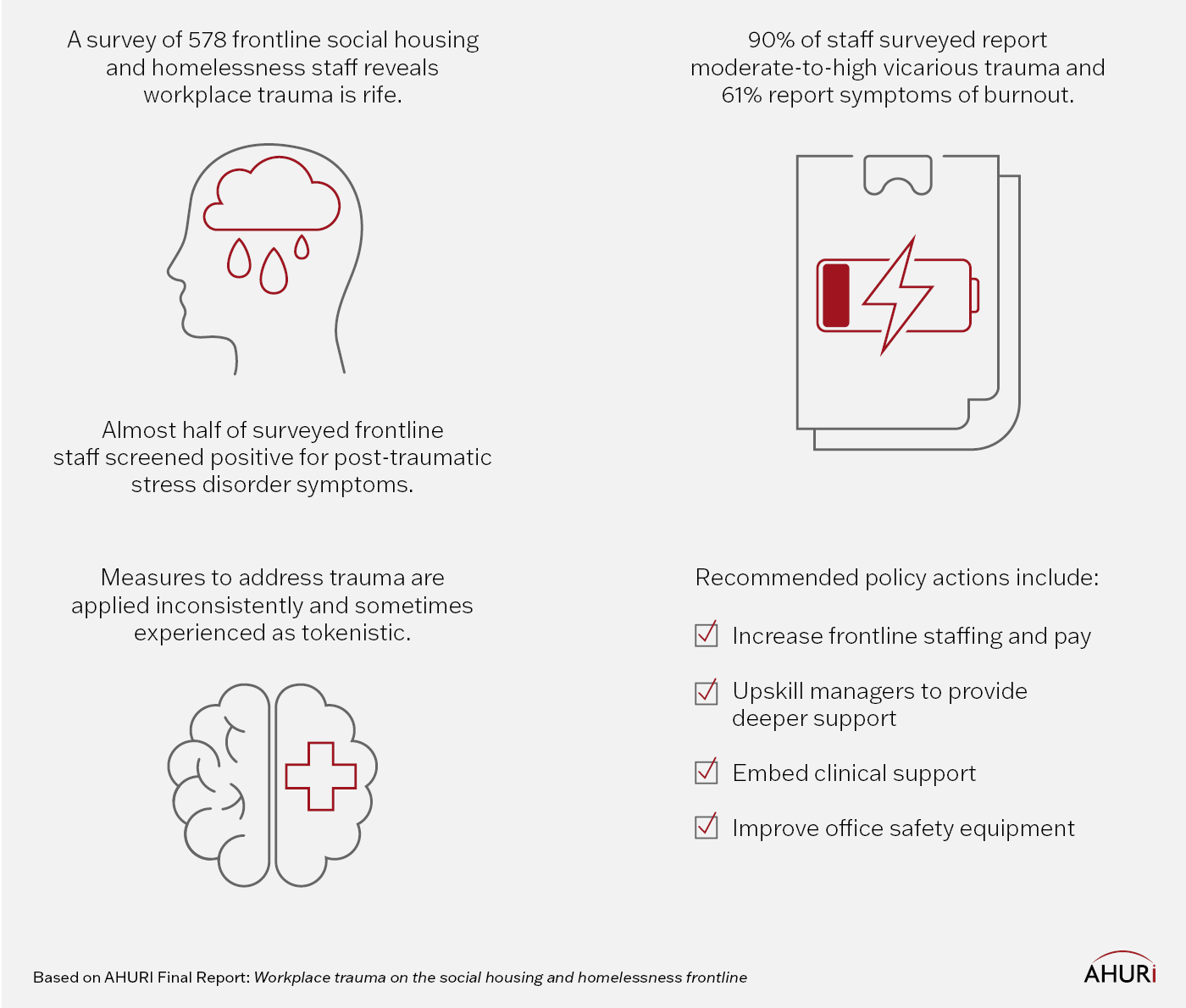
Exposure to workplace trauma is an almost universal experience. It’s frequent, cumulative, and embedded in frontline housing and homelessness work.

People working in the housing and homelessness sector are exposed to significant trauma due to their role as service providers, often of last resort, for people who commonly have complex needs. Setting out to explore the extent, causes and impacts of that workplace trauma, researchers utilised a national survey of frontline staff in the housing and homelessness sectors, ran interviews with frontline staff and stakeholders in New South Wales, Tasmania and Victoria, and conducted a range of workshops.


Published by AHURI in February 2026, the overriding key finding of this research is that
exposure to workplace trauma is an almost universal experience.  It’s frequent, cumulative, and embedded in frontline housing and homelessness work.


The national survey revealed that frontline workers had high exposure to:

  • Challenging behaviour: 98% observed clients/tenants under the influence of alcohol or drugs and 91% had supported clients/tenants with experiences of family violence.
  • Death, suicide and self-harm: 95% had spoken with clients/tenants about suicidal ideation, 88% had clients/tenants who had engaged in self-harm, and 78% had worked with a client/tenant who had died.
  • Threats and abuse: 96% experienced trauma due to verbal aggression, 85% due to threats against them or their families, 59% due to physical assault and 28% due to sexual assault from clients/tenants. 60% reported experiencing the presence of a weapon at work.


They also found that workplace trauma can be exacerbated by high caseloads, lack of supervision, and systemic factors including having to manage emergency situations created by failures and limitations of other services and processes. Organisations were also impacted as workplace trauma commonly created high staff turnover, increased illness, and difficulties with workforce recruitment and retention. 


Recommended policy actions

A range of policy actions were suggested by the researchers including:

  • Improved work design – such as increased staffing, smaller caseloads, guardrails to prevent overwork.
  • Improved conditions – including better pay and leave options as well as skills training.
  • Increased support for frontline staff – more clinical supervision and psychological first aid.
  • Increased accountability and collaboration – including improved information-sharing between agencies to minimise retraumatising clients.


Sean’s thoughts


This report could not come at a better time for the sector. For many years, we have been focussed on how to deliver services in a way that will allow our tenants and service users to engage meaningfully. This is perhaps most notably seen in our trauma-informed practices. This report highlights the workforce impact of these practices which cannot be understated. Indeed, these are conversations that we at the AHI have been having with members over the last six months. The impact of this work to the individual worker and the organisation is significant, and we all have a part to play in addressing it.


To find out more about this research project and read the full report go to https://www.ahuri.edu.au/research/final-reports/455

Share This Article

Other articles you may like

August 10, 2025
The AHI acknowledges the tireless efforts of those working within the homelessness sector, supporting the thousands of people experiencing homelessness and searching for meaningful pathways to live normal, productive and healthy lives. Our #HomelessnessWeek2025 sector forum in Sydney saw over 150 leaders, workers, politicians, policy makers, social impact collaborators, change makers and – most importantly - people with lived experience come together to talk about the impact of homelessness and share innovative responses within our community. Collaboration is key and the vibe in the room was inspiring. Real people making real differences. But we know it is far from enough and we must all strive to do more. We commend the NSW Minns Government, in particular the Hon Rose Jackson MLC, for their bold commitment to ‘make homelessness rare, brief and not repeated because people have a safe home and the support to keep it’ through the release of the NSW Homelessness Strategy 2025-2035. Thanks to Rebecca Pinkstone CEO Homes NSW and Dom Rowe CEO Homelessness NSW for their strong leadership and commitment to ending homelessness and providing more people with a home. The AHI continues to support and connect the workers who turn up, show up and get things done. Every single day. For more information, visit: https://www.nsw.gov.au/departments-and-agencies/homes-nsw/nsw-government-response-to-homelessness/nsw-homelessness-strategy-2025-2035 #HomelessnessWeek2025 #HomelessnessActionNow #Makeadifference #Leadingchange 
AI governance for community housing
By Dentons June 17, 2025
Love it or hate it, artificial intelligence is here to stay, and it’s playing an increasingly important role in housing. The Dentons team - Michael Park (Partner) and Antonia Hudson (Senior Associate) - provide us with a legal update on the use of AI for the Australian community housing sector, and AI governance tips for leaders of all organisations.
Harry Smith, new Australasian Housing Institute CEO
April 2, 2025
Harry Smith has recently commenced his role at the ahi as CEO after 26 years in the social services and government sectors across a range of diverse responsibilities. Harry brings a wealth of sector-specific knowledge and experience, supporting our members and our wider community.
More Articles