Overcoming Construction Constraints for the Supply of New Detached and High-rise Housing

The housing construction industry in Australia is at crisis point with no overarching strategy aimed at addressing housing construction constraints.

Published by AHURI in June 2026, this research provides the first significant examination of the ability of the Australian construction sector to deliver both detached and high-rise housing. It analysed construction workflows, markets, regulation, workforce, technologies and supply chains.


Researchers conducted 68 interviews with sector participants in Australia and internationally and undertook a thematic analysis of the interview transcripts. Policy testing workshops with industry stakeholders were held, and a comprehensive literature review was conducted. Construction simulation modelling and scenario modelling was also undertaken. All findings were presented to an expert panel, which provided guidance on ways to maximise the policy relevance. This research consists of the final report and three supporting projects.


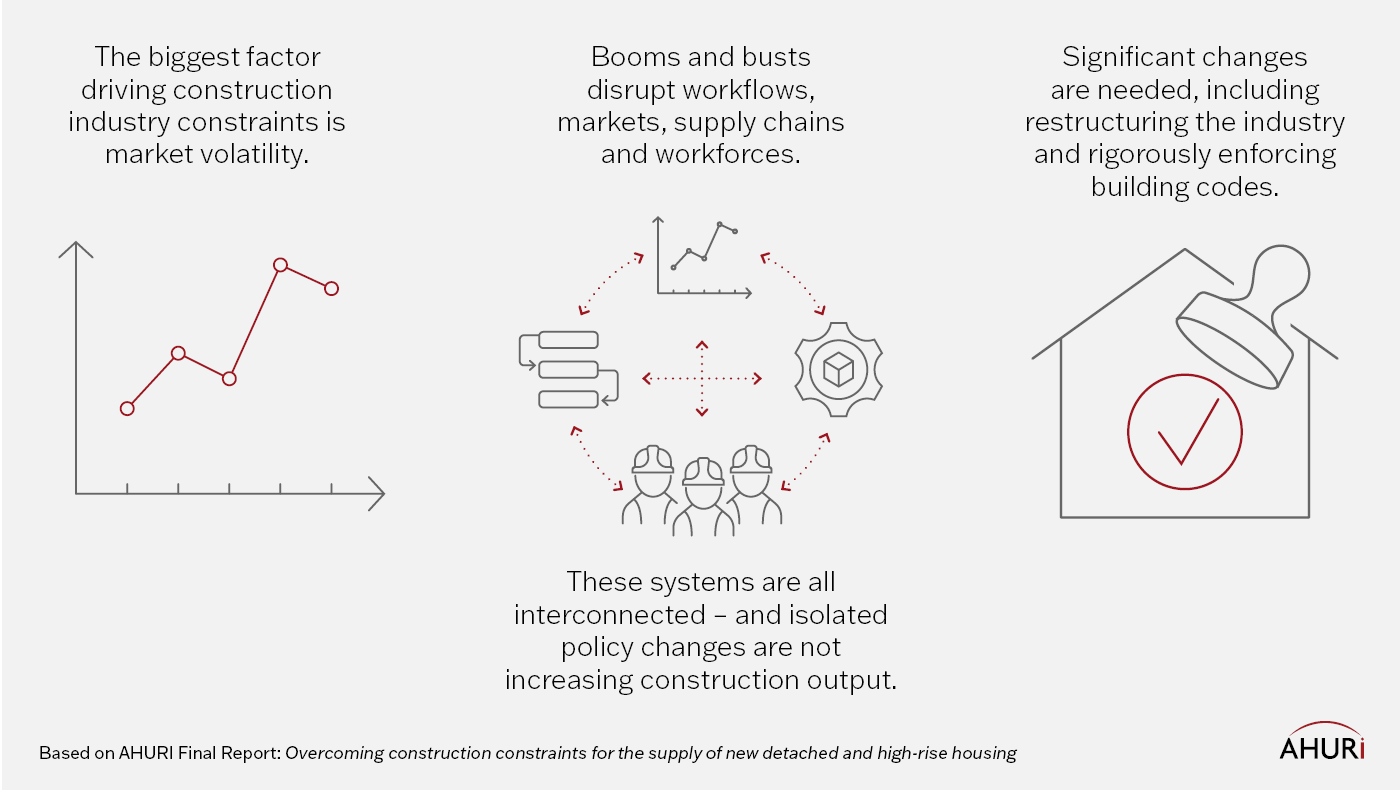
Key findings on sector issues include – market volatility is the most significant risk that builders face, subcontracting feeds loss of knowledge and lack of skills transfer across the sector, low builders’ margins increase cashflow risk and contribute to poor quality work, and building codes are inadequately reinforced. 


Recommended policy actions

Eight interconnected policy development options have been provided, however researchers have warned that refining and delivering on these policy directions will be challenging. 

  1. Develop a national strategy for efficient housing construction. Transforming the housing construction industry to improve productivity requires a focus on the system level, rather than isolated parts of individual subsystems. 
  2. Address market volatility. Market volatility is the key barrier to putting housing construction on the path to efficiency. 
  3. Modernise the regulatory framework. Inadequate building code enforcement supports inefficiency and risk shifting. Policy makers should harmonise the National Construction Code (NCC) across jurisdictions and ensure compliance.
  4. Attract and retain skilled employees. The extensive subcontracting that currently occurs shifts risks down the supply chain. It is recommended that a national construction training board be established to focus on workforce development.
  5. Include cost escalation provisions in contracts. Adversarial relationships and unfair contracting arrangements undermine best practice. Embedding fair and transparent cost escalation provisions within Design and Construct contracts will enable better risk sharing, sustainable procurement, and more stable and collaborative practices.
  6. Provide greater support for research and development. Government and industry need to provide financial support for R&D to drive productivity and facilitate a transition to net zero.
  7. Consider onshoring to reduce supply chain risks. The global supply chain is vulnerable to significant disruptions. Onshoring can reduce sovereign risk and supply chain risk. 
  8. Reduce market fragmentation. There is a need to reduce industry fragmentation and grow the size of firms, taking care to avoid excessive market concentration


Sean’s thoughts


For those of us trying to build social, community and affordable housing, this research confirms what we already know; the system we rely on to deliver homes is, itself, broken. The issues that are raised here are not abstract policy problems – they're the reason projects are stalling right now. AHURI is right that a national strategy is overdue. The social, community and affordable housing sector shouldn't have to wait for it. We need to be at the table making the case that without a functioning construction industry, every housing target in the country is fiction.


This is paragraph text. Click it or hit the Manage Text button to change the font, color, size, format, and more. To set up site-wide paragraph and title styles, go to Site Theme.

Share This Article

Other articles you may like

August 10, 2025
The AHI acknowledges the tireless efforts of those working within the homelessness sector, supporting the thousands of people experiencing homelessness and searching for meaningful pathways to live normal, productive and healthy lives. Our #HomelessnessWeek2025 sector forum in Sydney saw over 150 leaders, workers, politicians, policy makers, social impact collaborators, change makers and – most importantly - people with lived experience come together to talk about the impact of homelessness and share innovative responses within our community. Collaboration is key and the vibe in the room was inspiring. Real people making real differences. But we know it is far from enough and we must all strive to do more. We commend the NSW Minns Government, in particular the Hon Rose Jackson MLC, for their bold commitment to ‘make homelessness rare, brief and not repeated because people have a safe home and the support to keep it’ through the release of the NSW Homelessness Strategy 2025-2035. Thanks to Rebecca Pinkstone CEO Homes NSW and Dom Rowe CEO Homelessness NSW for their strong leadership and commitment to ending homelessness and providing more people with a home. The AHI continues to support and connect the workers who turn up, show up and get things done. Every single day. For more information, visit: https://www.nsw.gov.au/departments-and-agencies/homes-nsw/nsw-government-response-to-homelessness/nsw-homelessness-strategy-2025-2035 #HomelessnessWeek2025 #HomelessnessActionNow #Makeadifference #Leadingchange 
AI governance for community housing
By Dentons June 17, 2025
Love it or hate it, artificial intelligence is here to stay, and it’s playing an increasingly important role in housing. The Dentons team - Michael Park (Partner) and Antonia Hudson (Senior Associate) - provide us with a legal update on the use of AI for the Australian community housing sector, and AI governance tips for leaders of all organisations.
Harry Smith, new Australasian Housing Institute CEO
April 2, 2025
Harry Smith has recently commenced his role at the ahi as CEO after 26 years in the social services and government sectors across a range of diverse responsibilities. Harry brings a wealth of sector-specific knowledge and experience, supporting our members and our wider community.
More Articles